Peoria, Illinois, USA

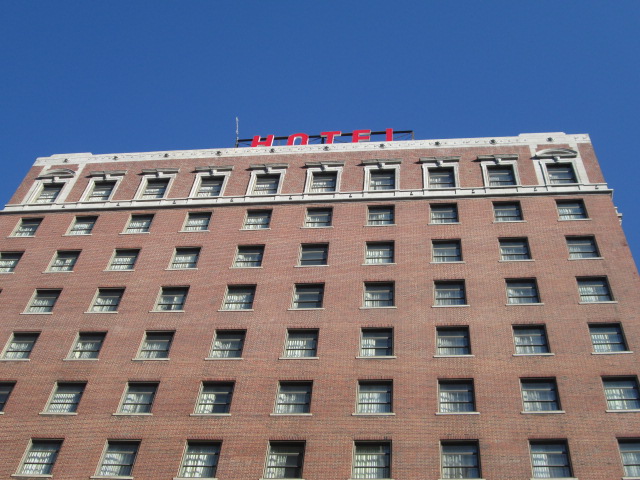
Rebuilt Pere Marquette Open June 28, 2013

06282013_hotel01.jpg

Pere Marquette reopens with a ‘spectacular’ new look


DAVID ZALAZNIK/JOURNAL STAR
Visitors walk through the former lobby area of the newly remodeled Peoria Marriott Pere Marquette Hotel Friday.
PEORIA — The early reviews — from local dignitaries to the first guests to check in — amounted to a unanimous and enthusiastic thumbs-up for the Peoria Marriott Pere Marquette Hotel.

The 86-year-old Downtown landmark reopened Friday. Make that 86 years new, because the hotel that closed in December 2011 is sporting a whole new look along with a new name.

“There are new ceilings, a new plumbing system. We replaced all the tile and the carpets,” said Gary Matthews, the president of EM Properties and the developer of the $93 million project that included a $44 million renovation of the 286-room Pere Marquette.

Part of the project, a 10-story, 116-room Marriott Courtyard Hotel, now under construction adjacent to the Pere, is expected to be completed by the second half of 2014.


Read more: http://www.pjstar.com/news/x208440872/Spectacular-Pere-Marquette-reopens-after-wholesale-renovation#ixzz2Zt08PUvw


________________________________


Peoria Downtown Hotel Project

Peoria Marriott Pere Marquette NOW OPEN, Marriott Courtyard Now Under Construction

Marriott, one of the world's top hotel companies, has taken over the landmark Hotel Pere Marquette in downtown Peoria after extensive renovation. The Peoria Marriott Pere Marquette is OPEN and the adjacent new 10-story Marriott Courtyard is under construction. The overall $92.8 million project will attract new and larger conventions and sporting events to the area, while enhancing value to the Peoria Civic Center and increasing local tourism business.

Pere Project
The Plan in 2009

Renovations included replacing all mechanical systems and plumbing aa well as overhauling each room and public area of the building. The newly refurbished 284 rooms at the Hotel Pere Marquette will nicely compliment the 116 rooms at the attached Courtyard by Marriott.
Other enhancements of the project include a connected skywalk between the hotels, Peoria Civic Center and a new parking deck.


Photos of the Pere July 23, 2013


Photos of the new Marriott under construction


Road Improvements Underway in the Warehouse District

Recent Project Updates

July 22, 2013: The time of the next public meeting on Tuesday, July 30, has been changed to 4:00pm.

July 18, 2013: The next construction meeting has been rescheduled to Tuesday, July 30 at 5pm 4pm. The meeting will be held at Dozer Park, located at Jefferson and Oak Streets. Guests should enter through the Administration Entrance doors on Oak Street. Parking is available in the Chiefs Staff/Player lot, accessible via the alley off Oak Street.

July 2, 2013: More detailed information regarding work areas and lane closures for July has been posted to our Construction page.

 Welcome!

As part of the City of Peoria's plans to encourage new development in the Warehouse District, the City of Peoria was awarded a $10 million grant from the U.S. Department of Transportation through the Transportation Investment Generating Economic Recovery (TIGER) II grant program. The Warehouse District TIGER II project will not only rebuild the street network but also improve safety, accessibility and aesthetics for residents and businesses in the Warehouse District.
Warehouse District and Washington Street Groundbreaking
U.S. Secretary of Transportation Ray LaHood, with (from left) Peoria Mayor Jim Ardis, former Peoria Mayor Richard Carver, Illinois State Senator Dave Koehler, and Peoria Councilman Ryan Spain, speaks at the March 8, 2013 Warehouse District TIGER II Complete Streets and Washington Street Improvement Projects groundbreaking.

Concurrently, the City of Peoria is also performing the Washington Street Improvement Project, which aims to transform Washington Street into a safer, more attractive facility for motorists and pedestrians alike. The Washington Street Improvement Project extends from Hamilton Boulevard to MacArthur Highway through the Warehouse District and Business District of downtown Peoria.
Warehouse District project areaThe Warehouse District project area includes the Warehouse District TIGER II Complete Streets project on streets shown in blue and the Washington Street Improvement Project, shown in red. The Washington Street Improvement Project also extends further north to Main Street. For a larger view of the study area, click here. Imagery: Bing Maps.
VISSIM traffic model showing traffic flows and lane configurations through the Warehouse District following completion of the improvements.

More Info at:


Craig Hullinger Returns to Peoria Part Time

Craig Hullinger AICP is now working for the City of Peoria part time helping facilitate redevelopment of the City.

Great things are happening in Peoria:

The Build the Block project is complete and the new CAT Visitor Center and Museum open.

The redeveloped Per Marquette Hotel is reopened, with another hotel under construction.

30 million dollars of construction are going into the streets creating attractive new urban streets in accordance with the Heart of Peoria Plan.

CAT is planning a major new Corporate Headquarters.


Let me know if there is anything I can help you with to get some deals done. I will be in the Peoria City Hall a few days a week, and available by phone 24/7


Craig Hullinger AICP


309 634 5557

City Web Site

peoriagov.org

City Economic Developing Info

peoriagov.org/community-development/economic-development


ECONOMIC DEVELOPMENT BLOGS

I will keep most of the new economic development news on the blog below:


Other Blogs of Interest


Peoria All American City

Peoria Wins 2013 All American City Award

Date: 
June 25, 2013

Peoria is once again an All American City!  Peoria has won the 2013 All America City Award!  Ten communities received the award at the All America City Award conference in Denver this weekend.  Peoria also won the separate online video contest and Elite Drum Corp member Ethan Mosher earned the distinct recognition of the All America City Youth Award.  The Peoria Chamber’s Young Professionals led this initiative and members say they are beyond thrilled at the support they received from individuals and businesses all across the region.
You can watch the presentation the Peoria delegation presented to the judges by clicking here:  http://www.youtube.com/watch?v=Sw7GUwAZKaI

If you haven't yet seen Peoria's "Forever Young" video entry you can view it herehttps://www.youtube.com/watch?v=HanJnGg4ZP4&feature=youtube_gdata_player.

More than 500 people participated in it and the final tally was more than 20,000 views and over 1,800 likes.

A delegation of 30+ people (including the Elite Drumline) went to Denver to present Peoria’s story to the National Civic League.  Thank you to everyone who participated in the All America City Award Peoria effort.  We will announce details for a press conference to present the award to the city later this week.


SynergiCity - New Book About Urban Redevelopment - Chapter on Peoria


With a particular emphasis on the Rust Belt of the American Midwest, SynergiCity argues that cities such as Detroit, St. Louis, and Peoria must redefine themselves to be globally competitive. This revitalization is possible through environmentally and economically sustainable restoration of industrial areas and warehouse districts for commercial, research, light industrial, and residential uses. The volume's expert researchers, urban planners, and architects draw on the redevelopment successes of other major cities--such as the American Tobacco District in Durham, North Carolina, and the Milwaukee River Greenway--to set guidelines and goals for reinventing and revitalizing the postindustrial landscape.

Contributors are Paul J. Armstrong, Donald K. Carter, Lynne M. Dearborn, Norman W. Garrick, Mark L. Gillem, Robert Greenstreet, Craig Harlan Hullinger, Paul Hardin Kapp, Ray Lees, Emil Malizia, John O. Norquist, Christine Scott Thomson, and James H. Wasley.

"Instead of handing over neighborhoods to city hall or private developers, this book shows that the solution to many cities' plights lies within them. Empowering residents to take control of and build on community assets, engaging them in community-based organizations that can spearhead revitalization and build real quality of place, yields real results. To the extent that they adopt a holistic approach to planning and build on a city's intrinsic strengths, they can accomplish miracles."--from the foreword by Richard Florida
Hardcover $60.00 Buy Now

* Full Disclosure - Ray Lees and I wrote a chapter.


Peoria Warehouse District Redevelopment

Ray Lees and Craig Hullinger at the Reconstruction of Washington Street in the Warehouse District


Reviving the Warehouse District

The city’s Warehouse District has earned a chapter in a recently-published book about developments in “the post-industrial city.”


Ray Lees and Craig Hullinger co-authored the chapter in “SynergiCity,” a compilation of essays edited by Paul Hardin Kapp and Paul Armstrong, both professors at the University of Illinois.
 
“SynergiCity” examines urban change since World War II when the industrial bases of many cities moved elsewhere

Click to read more:


pjstar.com/search?q=lees%20hullinger&submit=Search#ixzz2VWlxu7TB


Recent Project Updates

May 16, 2013: The next construction meeting has been moved to 5pm on Thursday, May 30. Please join us at the Gateway Building for more detailed information regarding upcoming construction and staging. Members of the project team will be on-hand to respond to any questions or comments.

As part of the City of Peoria's plans to encourage new development in the Warehouse District, the City of Peoria was awarded a $10 million grant from the U.S. Department of Transportation through the Transportation Investment Generating Economic Recovery (TIGER) II grant program. The Warehouse District TIGER II project will not only rebuild the street network but also improve safety, accessibility and aesthetics for residents and businesses in the Warehouse District.

Warehouse District and Washington Street Groundbreaking
U.S. Secretary of Transportation Ray LaHood, with (from left) Peoria Mayor Jim Ardis, former Peoria Mayor Richard Carver, Illinois State Senator Dave Koehler, and Peoria Councilman Ryan Spain, speaks at the March 8, 2013 Warehouse District TIGER II Complete Streets and Washington Street Improvement Projects groundbreaking.

Concurrently, the City of Peoria is also performing the Washington Street Improvement Project, which aims to transform Washington Street into a safer, more attractive facility for motorists and pedestrians alike. The Washington Street Improvement Project extends from Hamilton Boulevard to MacArthur Highway through the Warehouse District and Business District of downtown Peoria.


Warehouse District project area

The Warehouse District project area includes the Warehouse District TIGER II Complete Streets project on streets shown in blue and the Washington Street Improvement Project, shown in red. The Washington Street Improvement Project also extends further north to Main Street. For a larger view of the study area, click here. Imagery: Bing Maps.


Artist's Rendering, Oak Street at Adams Street

Artist's rendering of streetscape improvements and enhanced public space near O'Brien Field, on the northwest corner of Oak and Adams Streets. For a larger view, click here.

While the Warehouse District is larger than just the roadways included in this project, the TIGER II grant funding will go towards street repairs and streetscaping on side streets roughly bounded by Walnut Street on the north; Jefferson Street on the west; Persimmon Street on the south; and the Illinois River on the east. Improvements to other streets in the Warehouse District are expected to occur in the future.


Interesting Article in the Atlantic on Cities


The Coming Bold Transformation of the American City

In 40 years, 2.7 billion more people will live in world cities than do now, according to the United Nations Department of Economic and Social Affairs. Urban growth in China, India, and most of the developing world will be massive. But what is less known is that population growth will also be enormous in the United States.
The U.S. population will grow 36 percent to 438 million in 2050 from 322 million today. At today’s average of 2.58 persons per household, such growth would require 44.9 million new homes. However American households are getting smaller. If one were to estimate 2.2 persons per household—the household size in Germany today and the likely U.S. size by 2050—the United States would need 74.3 million new homes, not including secondary vacation homes. This means that over the next 40 years, the United States will build more homes than all those existing today in the United Kingdom, France, and Canada combined. Urban planner and theorist Peter Calthorpe predicts that California alone will add 20 million people and 7 million households by 2050.
To meet this demand, completely new urban environments will have to be created in the United States. Where and how will the new American homes be built? What urban structures are to be created?
penalosa_1_351  
Battery Park City in Manhattan exemplifies how the quality of urban life can be enhanced by replacing waterfront roadways with parks or pedestrian infrastructure. (Left); A "highway" for pedestrians, bicycles, and transit on Jiménez Avenue in Bogotá, Colombia. (Right) Photo courtesy of Enrique Peñalosa.

It is unlikely that city building on the scale to be seen through 2050 will happen ever again. Cities are a means to a way of life: the kind of urban structures created over the next few decades will have profound consequences in terms of quality of life, environmental sustainability, economic well-being, and even happiness and the civilization for hundreds of years to come. If we consider the influence American cities will exert on the rest of the world, the way they are built will determine, as well, much of the world’s sustainability and well-being.
Until today, the United States’ main legacy for the urban world has been low-density suburbs, which, most agree, have many shortcomings in terms of the environment and quality of life. The inadequacies of the suburbs are well known. They are high-energy-use environments: homes are large and thus consume much energy for cooling and heating; occupants’ mobility is dependent on the automobile; distances to reach jobs, shops, and recreation areas are long; and low-cost and high-frequency public transport is not viable in such a low-density environment. Suburbs severely restrict the mobility of vulnerable citizens—youngsters, the poor, and the very old—who usually lack access to a car. Because most destinations are unreachable on foot, suburban public spaces tend to be devoid of people—making them boring in their almost eerie silence interrupted only by the sound of cars that sporadically zoom by or lawnmowers with their maddening engines. Suburbs are not propitious for diversity: Russian literature courses or Afghan restaurants require high concentrations of people nearby from which to draw the small percentage who are interested.
Despite the ills of the suburbs, most Americans do not want to live in a Manhattan-like environment either. So, what should the third-millennium American city be like?