These comments are excerpted from a discussion I am having with C.J. Summers, a very smart young man who is a candidate for the Peoria City Council. His blog is well thought out, and I encourage you to read it.
_______________________________
Discussing incentives with Craig Hullinger
Craig Hullinger has written a blog post about the necessity of providing incentives to rebuild a city’s downtown/older neighborhoods. Hullinger used to be the Economic Development Director for the City of Peoria until he retired in 2009. Since that time, the City has not hired a replacement; instead, Economic Development personnel report directly to the City Manager du jour. Hullinger is a very nice guy and has said some kind things about my blog; nevertheless, we have some disagreements on economic development theory. “If an older city does not lead the redevelopment of its older central city, it will continue to decline,” Hullinger says. “[A] decision not to incent redevelopment is a decision to give up on your older areas…. [I]ncentives are required to rebuild downtown. Developers go where they are certain they can develop and get a great return. Redevelopment is much more costly and high risk then greenfield development. We have to equalize these costs through incentives if we want private sector renewal.”
What’s missing from this argument? It doesn’t specify what he means by “incentives.” An incentive is “any factor (financial or non-financial) that enables or motivates a particular course of action, or counts as a reason for preferring one choice to the alternatives.” If this is what we mean by “incentives,” then Hullinger and I do not disagree. I believe cities do need to invest in their older neighborhoods and to incentivize redevelopment where necessary. The point of disagreement is over the kind of investments and incentives that should be made.
Let’s look at a specific example of the kind of incentives to which I object. Hullinger talks about equalizing costs of redevelopment with greenfield development. One of the tools to accomplish this is something called an “enterprise zone.” Its very purpose is to help cities revitalize their older central cities by providing sales tax breaks on building materials or a partial property tax abatement. The City of Peoria’s enterprise zone looks like this:
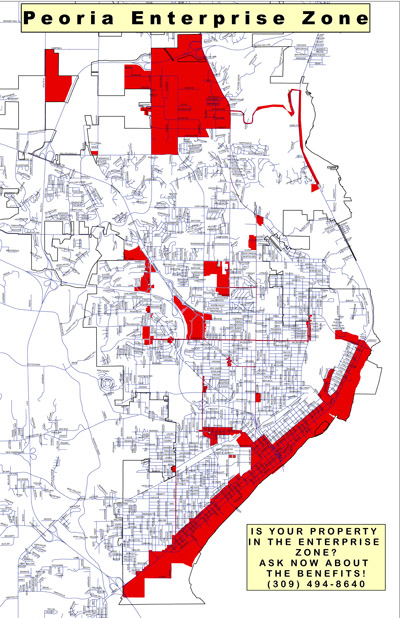
Notice where these incentives are predominantly going? Along the riverfront, and far north Peoria. Question: When the same incentives are given to greenfield sites as the central city, what effectiveness do they have? Answer: None. If anyone in the city can receive Enterprise Zone status, it’s no longer an incentive to locate in the central city. It loses all effectiveness, and becomes nothing more than developer welfare — a perk for the well-connected, like Firefly Energy, which you can see received EZ status on the map above (the thin red line that snakes down Detweiller Drive and Route 29 to the old Foster and Gallagher site). EZ status was even used as an annexation tool to keep a pizza place from moving out of the City — a pizza place that had already received an incentive from the City in the form of a business development loan.
When you eviscerate your economic development tools like this, it leads to an arms-race for more extravagant incentives to draw people to the central city. And that needlessly costs the taxpayers more money. We need to maximize the effectiveness of our economic development tools, and that means (among other things) using them where they’re needed, and not using them where they’re not needed.
And under no circumstances should we give a $9 million fee to a private developer to build a private hotel for his private profit. That’s not economic development. It’s pure, unadulterated developer welfare — welfare we can’t afford.
________________
Craig replies
Excellent posts by you and many of your readers, CJ
Government incentives for business development is always controversial. Let me respond to some of your points.
Many older cities and regions around the country use Enterprise Zones. There are large number of incentives bundled into the Zones to try to incent development or redevelopment in the zones.
The original intent of the zones was to try to attract redevelopment back into poor areas. When you look at the Peoria map you see that a large part of the zone is in the poor south end of the city.
But around the State enterprise zones were quickly expanded to include industrial areas and some commercial areas that are not blighted, as you can see from the Peoria map. This was an effort to compete with other areas and States for economic development.
The incentives in the Enterprise Zone are not that great. The two big incentives are sales tax for building material for new or improved facilities. The sales tax is mostly paid to the State of Illinois, the City and a little to the County. So these three governments are willing to forgo the sales tax on building material for a new facility that will produce jobs and property tax for many years. Pretty good trade off, I would say. And so would most people, I think, especially with our high unemployment.
The other large incentive is 5 years of property tax abatement for primarily for industrial development – not commercial. And School District 150 and the Dunlap School District do not participate – each government decides whether it wants to participate or not. So the other governments did decide to participate – and I think for pretty logical reasons. They give up 5 years of the new property tax for new industrial developments that generate jobs and permanent tax base.
Pretty good deal, I would say.
Now lets consider a typical meeting with developers that occur frequently (we hope). A developer approaches the EDC or City and says we have a company that wants to open a facility in the Midwest. We are looking at Indiana, Illinois, and Iowa. We will invest $5,000,000 and will create 60 jobs. Your area looks good. We are checking out incentives.
We know that they will get a good incentive package from communities in the other states and around Illinois.
We discuss our incentive package and tell them we will work with them and the State on State incentives. We sell our town as hard as we can.
The developer will typically sum up all his findings on a spread sheet, and figure out the best place to build.
So we are in competition with numerous other communities. You can decide to compete or not.
I say compete.


 Out of nearly 100 participants, 41% believe the recession is over. When asked if there would be a double dip to this recession 63% said no. To find out what Mood-O-Meter participants said they needed to see to believe the recession is over

 We had great success in 2010 so we are expanding Project Pack the Place this year. There will be events for groups & individuals this year plus we're adding more venues & even restaurants to the list of places to pack in 2011.